When I showed my ability to go back in time for the first time in the space-time maze of Prince of Persia: The Lost Crown, the familiar Persian prince seemed to stand in front of me again after fifteen years. But surprisingly, Ubisoft did not simply reproduce the classics, but used Metroidvania’s new coat to revive the former home computer king in an unexpected way.
The game opens at the junction of Persian mythology and history. I played the role of the young warrior Sargon and joined the elite guard “The Immortals” to rescue the kidnapped prince Prince Ghassan. But what really makes this restart work charming is its modernization of the essence of the series — the classic time control ability is no longer just a puzzle-solving tool, but also perfectly integrated with the high-speed combat system. When I paused for time to immobilize the enemy, and then flew between the walls with my gecko-like skills, the smooth operation reminds me of the golden age of classic action games.
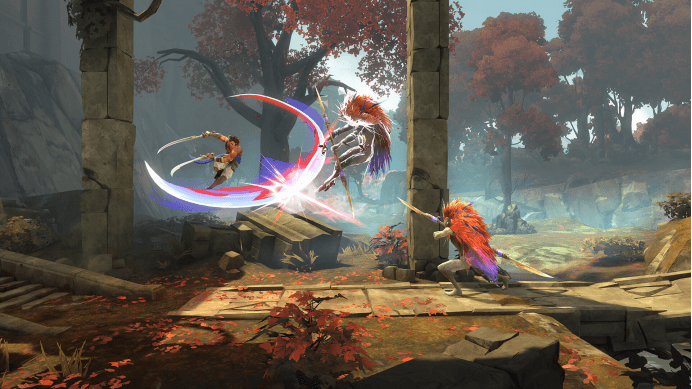
The most amazing design lies in its in-depth exploration of Persian mythology. Each region comes from the legend of the Persian epic _Shahnameh_: from the Temple of Mitra, which symbolizes light, to the Ogre’s Lair, which represents darkness, from the Eternal Battlefield, which is still in time, to the Mirror of Heaven, which is misaligned in space.of Heaven. I remember that in the “The Forgotten Citadel” level, I need to constantly switch between the past and the present, and watch the ruins restore their former glory in the passage of time — this design that perfectly combines narrative and mechanism makes each puzzle a moving story chapter.
The game’s grasp of the difficulty curve is textbook-level. Through the innovative “Memory Shard” system, players can leave clues at key locations, greatly reducing the common lost troubles in Metroidvania games. A variety of switchable difficulty options not only cater to casual players who want to experience stories, but also satisfy the core players who pursue challenges. The most considerate is the “Exploration Mode” — when the level is stuck for more than a certain time, the game will take the initiative to provide puzzle-solving tips, which is rare in similar games.
As the adventure deepens, Sargon’s growth trajectory is moving. From the initial loyal members of the guard, to gradually questioning their mission, and finally finding the truth in the paradox of time and space — this character is very impressive. When he faced that heartbreaking choice at the end, I found that I was no longer operating a virtual character, but witnessing the birth of a hero.
On the weekend after customs clearance, I re-examined the first _Prince of Persia_ in 1989. This series spanning 35 years can last for a long time, precisely because Ubisoft understands that the real classic rebirth is not a simple reproduction, but a new life in line with the times while retaining the soul. If you were also a prince of Persia, _The Lost Crown_ will give you the most perfect return gift. It is not only a tribute to the golden age, but also a love letter to players in the new era.